

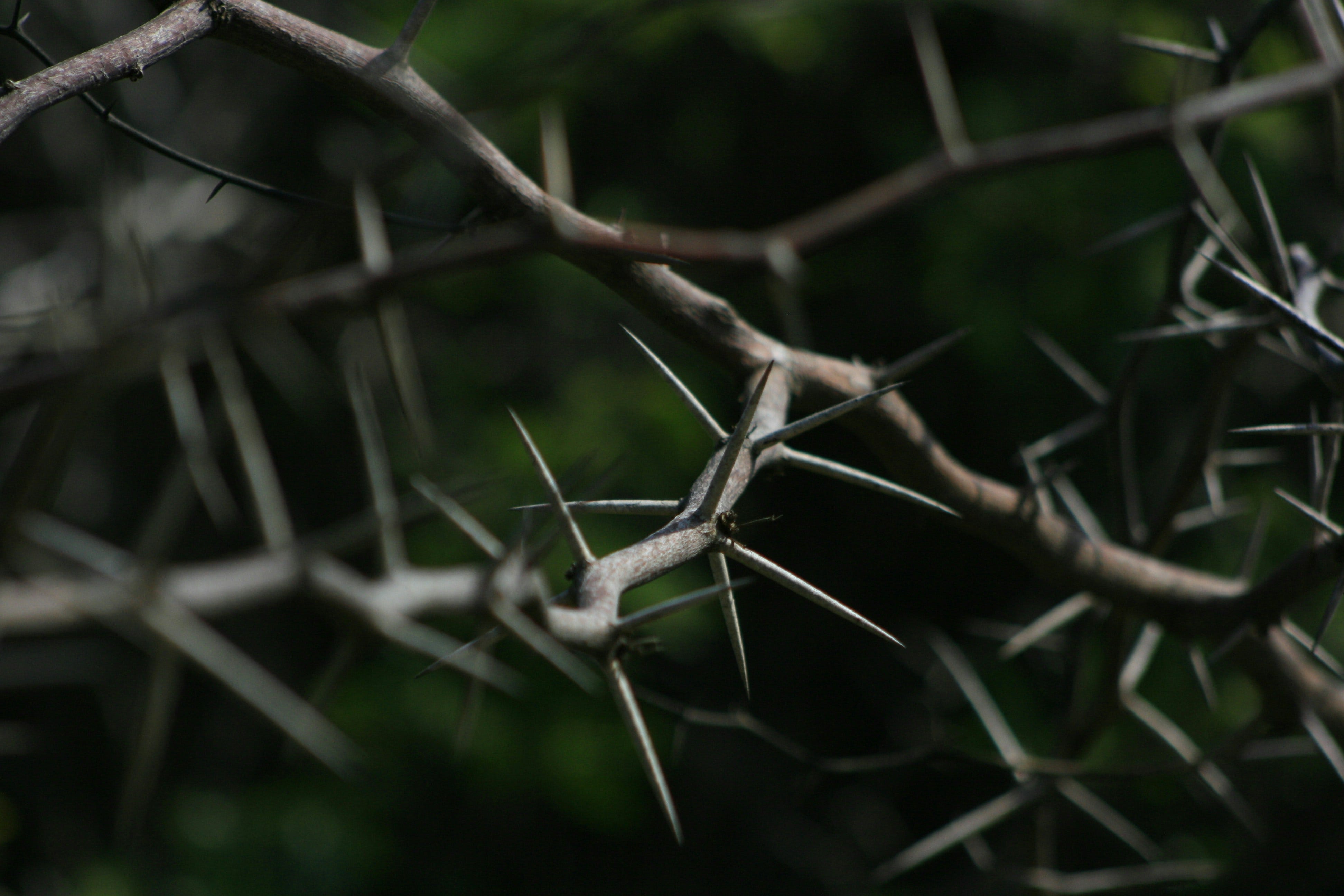
There is a moment in the Passion when cruelty grows strangely ceremonial. Violence pauses to arrange itself. The soldiers cannot simply kill Him, they must first perform the theater of kingship. A crown must be made. Even mockery requires its liturgy.
So they gather the branches of a thornbush: the refuse of the ground, the small weapons the earth has learned to grow since Eden broke. Rough hands twist them together, shaping a circle, the ancient geometry of rule. Then they press it down upon His head.
The Gospels hurry past the moment. A line, scarcely more. Yet the imagination cannot move so quickly. It sees the thorns settling into flesh, the dark line of blood gathering at the brow. It hears the laughter, that brittle laughter of men who have discovered that suffering can be entertaining if it belongs to someone else.
They kneel before Him in parody. “Hail, King.”
And yet the mockery keeps betraying itself. The robe becomes royal whether they intend it or not. The reed becomes a scepter. And the crown they fashion from the cursed growth of the earth becomes, against all intention, the only crown that could truthfully rest upon His head.
For thorns have a history.
They entered the world when harmony fractured. When humanity turned inward upon itself, the wound didn’t remain confined to the human heart. It spread outward into the soil. The ground began to resist. The earth learned to grow thorns and thistles, the small signatures of a creation that had begun to suffer.
If one stares at this long enough you notice something terrible and beautiful: the crown forced upon Christ is woven from the very symbol Scripture gives to the earth’s grief.
The soldiers believe they are humiliating a pretender. In truth, creation itself is crowning its King.
The thorns do more than pierce skin. They reveal the logic of the Incarnation in its most unbearable clarity. God doesn’t redeem the world from a distance. He enters its wound. The pain embedded in creation since the first fracture gathers now upon the head of the One through whom the world was made.
The curse returns to its source.
The resistance of the soil, the violence that creeps through nature, the long groaning of a world that has forgotten its original music… all of it presses into His flesh. The suffering of creation finds its way into the mind of God.
And once it enters the mind of God, it cannot remain the same.
That is the secret hidden in this brutal coronation. The thorns still wound Him, but they no longer belong only to the curse. They have been taken up into redemption. The symbol of the earth’s rebellion has become the crown of its reconciliation.
The soldiers don’t know this. They are merely amusing themselves in the governor’s courtyard. Yet in their cruelty they perform a liturgy older than empire. They place upon Christ the grief of the world.
And He receives it.
He doesn’t lift the crown away. The thorns remain where they are placed, drawing blood with every breath, every movement of His head, every step toward the hill. It is the only crown a wounded world could give its King.
But the story of those thorns is not finished.
For the head that bears them will soon bow in death. The body that carries the wound of creation will lie in the quiet darkness of a tomb. And the earth that once grew the branches of mockery will keep turning in silence, bringing forth thistles and wheat together, waiting without knowing that it waits.
Until one morning the ground will open again.
And when life rises where death was planted, the meaning of that crown will be revealed. The thorns will no longer speak only of curse. They will speak of a King who wore the wound of creation until the wound itself became the beginning of a new world.
I can only press the heart symbol once, but this writing will stay in my heart today. Thank you.
The image of cruelty arranging itself into ceremony — mockery that cannot help becoming coronation — I hadn’t seen it that way before. The thorns carrying the grief of creation back to its source. That’s a gift of a piece. Thank you.