

The dust of the Lenten journey doesn’t remain politely upon the forehead where the priest first placed it. It works its way inward, entering the lungs, the hidden chambers of the heart. What begins as a ritual sign slowly becomes a physical knowledge that we are made of the same fragile matter that returns, inevitably, to the earth.
But ash isn’t only a symbol of mortality. It’s the residue of fire.
The Church places it upon us at the beginning of Lent because something in the human soul must burn before it can love truthfully. For forty days we walk with the taste of that dust in our mouths. Prayer becomes spare. The interior life loses its ornamentation. Beneath the habits of religion there appears the more austere landscape of the desert, the place where illusions collapse under the weight of silence.
At first we imagine this stripping has a clear moral purpose. We fast, confess, examine our lives with a quiet severity. The spiritual imagination tends naturally toward purification. We assume the goal is to emerge from Lent cleaner, more disciplined, better prepared for heaven. And it is.
But the desert is patient.
If one remains within its silence long enough, another thirst slowly surfaces beneath the thirst for purity. It’s more dangerous and infinitely more intimate. One begins to suspect that salvation was never meant to be a private possession, something polished like a stone and carried safely in the pocket of the soul.
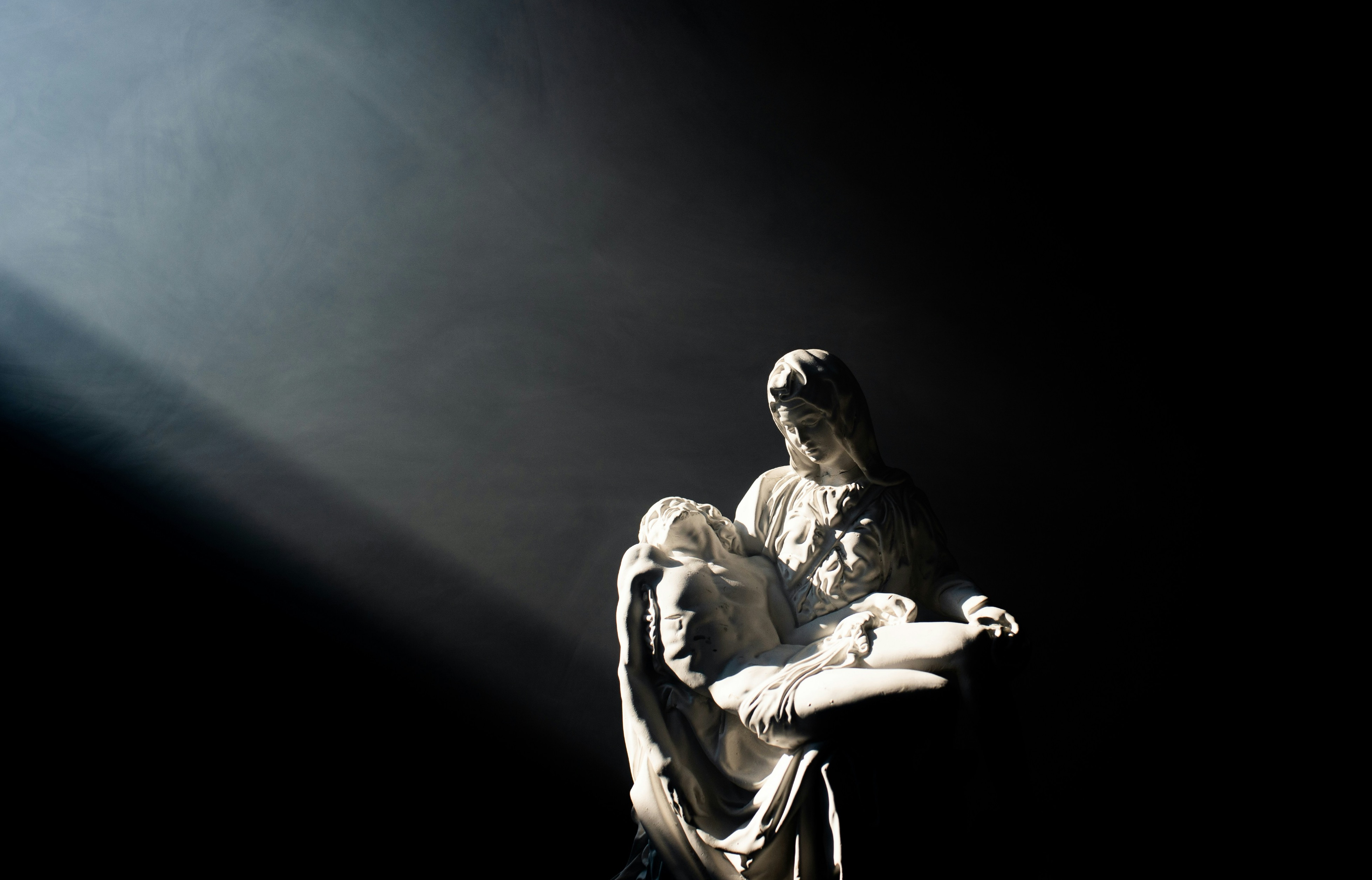
The Cross waits at the far edge of the desert to reveal this truth, and the Cross doesn’t stand alone. There’s a figure beneath it who doesn’t move. The old hymn names her: Stabat Mater. The Mother stood.
No speeches are recorded. No protest interrupts the execution. The Gospel offers only this austere image of presence, love occupying the exact place where love is most wounded. She doesn’t faint or turn away. She remains.
And in that remaining she becomes the most devastating theologian the Church has ever known.
For the human instinct when confronted with suffering is flight. We rationalize it, anesthetize it with explanations or distance. Even religion often becomes an instrument of escape, a way to climb out of the gravity of human pain and into a cleaner, spiritual altitude.
Mary refuses this instinct entirely. She stands within the catastrophe.
The Incarnation makes such standing inevitable. If the eternal Word has truly taken flesh, then flesh… perishable, capable of being torn open… has become the place where God chooses to be known. Divinity no longer hides safely beyond the reach of suffering. It inhabits it.
The broken body on Golgotha is therefore not an unfortunate episode in the Divine story. It is its most exact revelation.
Love, in its final form, refuses immunity.
The wound in Christ’s side isn’t merely the consequence of violence. It’s an opening through which the interior life of God becomes visible. What flows from that wound is not simply blood and water, but the disclosure of a love that chooses proximity to the world’s pain rather than distance from it.
The fourteenth-century mystic Julian of Norwich experienced this disclosure as a literal invitation into the Divine heart, recording that Christ “led his creature’s understanding through the same wound into his side within. And there he showed a fair, high place, large enough for all mankind... to rest in peace and in love.”1
Those who deeply contemplate the Passion begin to feel a terrible gravity pulling the heart downward. The spiritual life ceases to resemble an ascent into purity. It becomes a descent into solidarity. This descent changes everything.
At the beginning of faith the soul is preoccupied with itself, its progress, its destiny. Prayer often resembles a quiet negotiation between the creature and its Creator. The central question remains politely self-referential: How can I be saved?
But something happens when the Cross is allowed to remain in the field of vision long enough. The face of Christ begins to multiply.
The crown of thorns becomes the humiliations suffered by those whose lives the world has judged expendable. The nails become every act of cruelty carried out in the name of power or indifference. The thirst becomes the unbearable dryness of lives abandoned to loneliness, war, exile, addiction, grief.
One begins to see that Golgotha is not a moment sealed within history but a pattern woven through every century. The Body of Christ continues to appear wherever human beings are crushed beneath forces too large to resist. And suddenly the language of salvation changes. The soul discovers that the wounds of Christ and the wounds of humanity are not two realities but one torn body. To enter the Passion of Christ is to enter the suffering of the world itself.
This is the meaning of compassion. Not sentiment nor the thin emotion that passes quickly across the surface of the heart. The word in its older meaning is far more severe: to suffer with. To remain present where instinct demands escape.
As Simone Weil observed, this kind of presence is no ordinary thing: “The capacity to give one’s attention to a sufferer is a very rare and difficult thing; it is almost a miracle; it is a miracle. Nearly all those who think they have this capacity do not possess it. The warmth, the heart-rending emotion... are of no use.”2
Radical solidarity begins here.
The contemplative who walks this path finds the neat architecture of personal piety quietly collapsing. Prayer lists for “my salvation” blur and smear beneath the weight of another question altogether.
How can I stand here and not turn away?
Lent, seen in this light, becomes preparation for a different kind of courage. Fasting teaches the body to share hunger. Silence trains the ear to hear the cries that society has buried beneath noise. Almsgiving becomes a small, trembling refusal to pretend that another person’s suffering belongs to another world.
None of these acts repair the world. But they refuse abandonment, and this refusal changes the soul.
One begins to understand something that Mary understood beneath the Cross: love is not measured by its ability to solve suffering but by its refusal to desert those who endure it.
This is why the most devastating moment in the Passion doesn’t arrive with the earthquake or the torn veil. It arrives later, in the long, unlit hours of Holy Saturday. The body has been lowered. The stone seals the tomb. Heaven offers no explanation.
The Mother still stands.
Here one encounters the most frightening dimension of co-suffering love: the willingness to remain present even when God appears silent. To hold the weight of the world’s grief without immediate redemption. To stay where hope itself seems suspended.
And it’s precisely here, in that terrible, patient fidelity, that the deepest mystery of Divine love begins to emerge, because love that descends into the lowest regions of suffering acquires a strange and indestructible power. It cannot be humiliated or exhausted. It cannot be finally defeated.
Every human act of radical solidarity becomes a small continuation of the Passion. A bedside vigil beside the dying. A refusal to abandon the forgotten corners of the world where suffering accumulates quietly.
Beneath the frailty of these gestures runs the same current that flowed through the wounds of Christ, a love that chose to descend all the way into human darkness. And in descending that far, it discovered that there’s no depth in which God is not already waiting.
Revelations of Divine Love
Waiting on God
What a brilliant piece. Thank you so much, Steve.
“The mother stood.” What an image—and what a profound reflection on how we are called to respond to the immense pain accumulating in the world.
What if God is harnessing the energy that flows from surrendered hearts—those who choose to stand—and through them bringing about his purpose in the cosmos: the embodiment of the cosmic Christ.
“love that descends into the lowest regions of suffering acquires a strange and indestructible power. It cannot be humiliated or exhausted. It cannot be finally defeated.” Wow. Your writing is so clear and profound. Thank you. The line above really grabbed me. This has rung true in my life. I know I’m not alone. You put words on it quite well.